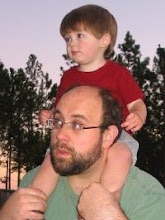
Today makes the third year I've been able to celebrate Father's Day as a Father.
Is it different? Yes, quite different. Father's Days used to bring me only depression; I spent too much time thinking of my own father, wondering what he'd think of me were he still alive, wondering if I were living up to his expectations, wondering if I'd ever see this day any other way. These days, I still think of my father, certainly. I still wonder about him.
But I also look at my own son, and I remember that I've got to be his old man. I've got to provide for him. I've got to teach him all those things that a father is supposed to teach--and I'm still trying to figure out what those things are.
This is a song that I wrote a while back--it's an instrumental, so don't expect my terrible voice. Instead, I tried to write a melody that suggested Ben, my son: how cute he is, certainly, but also his personality, how open he is to the world, how friendly he is. The melody is based on a D-major scale (and the piece is in the key of D); in the pre-chorus, however, I use a Gmaj7 rather than G natural. Doing so gives the piece a kind of jazzy flavor and adds a bit of texture to the melody (I hope). The Gmaj7 also makes me think of Ben--it stands out in a crowd and asks, however politely, that you pay attention.
Happy Father's Day to all readers of this blog. I appreciate your stopping by time to time. I hope to update more in the future.
Little Man (Song for Ben) (MP3)
21 June 2009
26 May 2009
Basil Bunting
Bloodaxe Books to Release New Edition of Briggflats with Companion CD & DVD
Basil Bunting is one of the most important British poets of the 20th century. Acknowledged since the 1930s as a major figure in Modernist poetry, first by Pound and Zukofsky and later by younger writers, the Northumbrian master poet had to wait over 30 years before his genius was finally recognised in Britain – in 1966, with the publication of Briggflatts, which Cyril Connolly called ‘the finest long poem to have been published in England since T.S. Eliot’s Four Quartets’.Don Share has an enlightening, astute essay about Briggflats and Basil Bunting here.
25 May 2009
24 May 2009
Poems & Music
I’ve been thinking a lot about poetry’s connection to & interaction with music. I don’t mean music in an abstract way: critics often call poetry “musical” or rave about a poet’s ear, a musical metaphor. I know because I’ve used these terms. I’m talking subject matter here, not poetics.
Is a poem about a piece of music considered ekphrastic? When one thinks of ekphrastic poems, the usual suspects come to mind: Auden’s “Musée des Beaux Arts,” Keats’ “Ode on a Grecian Urn,” a few others. But what about poems that directly address music? Is there a term for such a thing?
I’m well aware of poets addressing jazz, using jazz not only rhythmically in verse, but also addressing jazz as subject. Yusef Komunyakaa & Sascha Feinstein’s The Jazz Poetry Anthology comes to mind. I’m also thinking of various pieces by Langston Hughes, Terrence Hayes, Ed Pavlic, Jake Adam York, & a host of other poets, both classic & contemporary. What I don’t know, however, is if there is a critical term for such a poem—or even if there is a need for a critical term.
Recently, I’ve been reading through Jim Elledge’s Sweet Nothings: An Anthology of Rock & Roll in American Poetry. I sought out the book because I’ve been writing poems about rock & roll—particularly the rock & roll of my late teens & early twenties: grunge. Elledge’s anthology is a fine selection, if not uneven, with some outstanding pieces by David Graham, William Matthews, Tad Richards, Rachel Loden, & Judson Mitcham, among others. The poets’ various engagements with rock & roll hold the anthology together: it’s a subject-driven book. Overall, the poems in the book don’t interrogate the notion of rock or the notion of music. Elledge’s introduction does little more than place the poets historically—not that this is a bad thing.
But I’m interested in how poetry can become a way of understanding music—what underpins it, what drives it, what makes it last, what makes it die. Why do generations of Baby Boomers swoon over Bob Dylan? I am not dismissing Dylan; I love his music. Rather, I ask: why him? Why his music? What about Dylan captures the ebb & flow of a particular generation?
For me, the question returns to a figure like Kurt Cobain. Simultaneously a commodity & an artist, he helped change popular music in a way that few had done before. It’s easy, retrospectively, to snicker at him—to snicker at the entire grunge movement. The flannel, the attitude, the sloppy musicians: it all adds up to a bad joke, a prepackaged “movement” to sell to disaffected teenagers, who were the offspring of former disaffected teenagers, who will one day have disaffected teenagers of their own. Cobain exemplifies corporate art. Let me be clear: I don’t argue that Nirvana lacked merit; I only argue that the band became a corporate label—rebellion wrapped in cellophane.
But the question arises: is Dylan any different? Are the Beatles different? Elvis Presley? Sam Cooke? What happens when the corporate & the artistic meet?
The poems I’ve been writing lately have addressed this question; hence, my search for a critical vocabulary. Leave me a comment if you know of any books I should track down, either books of poems or critical studies.
Is a poem about a piece of music considered ekphrastic? When one thinks of ekphrastic poems, the usual suspects come to mind: Auden’s “Musée des Beaux Arts,” Keats’ “Ode on a Grecian Urn,” a few others. But what about poems that directly address music? Is there a term for such a thing?
I’m well aware of poets addressing jazz, using jazz not only rhythmically in verse, but also addressing jazz as subject. Yusef Komunyakaa & Sascha Feinstein’s The Jazz Poetry Anthology comes to mind. I’m also thinking of various pieces by Langston Hughes, Terrence Hayes, Ed Pavlic, Jake Adam York, & a host of other poets, both classic & contemporary. What I don’t know, however, is if there is a critical term for such a poem—or even if there is a need for a critical term.
Recently, I’ve been reading through Jim Elledge’s Sweet Nothings: An Anthology of Rock & Roll in American Poetry. I sought out the book because I’ve been writing poems about rock & roll—particularly the rock & roll of my late teens & early twenties: grunge. Elledge’s anthology is a fine selection, if not uneven, with some outstanding pieces by David Graham, William Matthews, Tad Richards, Rachel Loden, & Judson Mitcham, among others. The poets’ various engagements with rock & roll hold the anthology together: it’s a subject-driven book. Overall, the poems in the book don’t interrogate the notion of rock or the notion of music. Elledge’s introduction does little more than place the poets historically—not that this is a bad thing.
But I’m interested in how poetry can become a way of understanding music—what underpins it, what drives it, what makes it last, what makes it die. Why do generations of Baby Boomers swoon over Bob Dylan? I am not dismissing Dylan; I love his music. Rather, I ask: why him? Why his music? What about Dylan captures the ebb & flow of a particular generation?
For me, the question returns to a figure like Kurt Cobain. Simultaneously a commodity & an artist, he helped change popular music in a way that few had done before. It’s easy, retrospectively, to snicker at him—to snicker at the entire grunge movement. The flannel, the attitude, the sloppy musicians: it all adds up to a bad joke, a prepackaged “movement” to sell to disaffected teenagers, who were the offspring of former disaffected teenagers, who will one day have disaffected teenagers of their own. Cobain exemplifies corporate art. Let me be clear: I don’t argue that Nirvana lacked merit; I only argue that the band became a corporate label—rebellion wrapped in cellophane.
But the question arises: is Dylan any different? Are the Beatles different? Elvis Presley? Sam Cooke? What happens when the corporate & the artistic meet?
The poems I’ve been writing lately have addressed this question; hence, my search for a critical vocabulary. Leave me a comment if you know of any books I should track down, either books of poems or critical studies.
23 May 2009
Geoffrey Hill
[Geoffrey] Hill, however, may have no living peer; may even have no counterpart in the last century. There is no qualification necessary. This is not to say that he has never written a poem that was flawed, or failed — he is human, and one does not want to give the impression of infallibility. However, more than any other poet writing today, Hill’s vision of poetry is powerful, meaningful to every edge and nook of our society, and idiosyncratic: that radical atonement of emotion, intellect, history, and language, is an unparalleled achievement in our time.
—Daniel E. Pritchard on Geoffrey Hill's Selected Poems
Labels:
Favorite Poets,
Internet Articles
06 May 2009
04 May 2009
Somebody Loves Us All
Filling Station
Elizabeth Bishop
Oh, but it is dirty!
—this little filling station,
oil soaked, oil-permeated
to a disturbing, over-all
black translucency.
Be careful with that match!
Father wears a dirty,
oil-soaked monkey suit
that cuts him under the arms,
and several quick and saucy
and greasy sons assist him
(it's a family filling station)
all quite thoroughly dirty.
Do they live in the station?
It has a cement porch
behind the pumps, and on it
a set of crushed and grease-
impregnated wickerwork;
on the wicker sofa
a dirty dog, quite comfy.
Some comic books provide
the only note of color—
of certain color. They lie
upon a big dim doily
draping a taboret
(part of the set), beside
a big hirsute begonia.
Why the extraneous plant?
Why the taboret?
Why, oh why, the doily?
(Embroidered in daisy stitch
with marguerites, I think,
and heavy with gray crochet.)
Somebody embroidered the doily.
Somebody waters the plant,
or oils it, maybe. Somebody
arranges the rows of cans
so that they softly say:
ESSO--SO--SO--SO
to high strung automobiles.
Somebody loves us all.
Elizabeth Bishop: The Complete Poems (New York: Farrar, Staus and Giroux), 1969.
Elizabeth Bishop
Oh, but it is dirty!
—this little filling station,
oil soaked, oil-permeated
to a disturbing, over-all
black translucency.
Be careful with that match!
Father wears a dirty,
oil-soaked monkey suit
that cuts him under the arms,
and several quick and saucy
and greasy sons assist him
(it's a family filling station)
all quite thoroughly dirty.
Do they live in the station?
It has a cement porch
behind the pumps, and on it
a set of crushed and grease-
impregnated wickerwork;
on the wicker sofa
a dirty dog, quite comfy.
Some comic books provide
the only note of color—
of certain color. They lie
upon a big dim doily
draping a taboret
(part of the set), beside
a big hirsute begonia.
Why the extraneous plant?
Why the taboret?
Why, oh why, the doily?
(Embroidered in daisy stitch
with marguerites, I think,
and heavy with gray crochet.)
Somebody embroidered the doily.
Somebody waters the plant,
or oils it, maybe. Somebody
arranges the rows of cans
so that they softly say:
ESSO--SO--SO--SO
to high strung automobiles.
Somebody loves us all.
Elizabeth Bishop: The Complete Poems (New York: Farrar, Staus and Giroux), 1969.
Labels:
Favorite Poets,
Favorite Writers
Subscribe to:
Posts (Atom)